

If you’re thinking “i’m 25 and earning ₹30k a month how should i start investing for long-term growth?”, you’re already ahead of most people your age. Not because of how much you earn—but because you’re thinking in terms of systems, compounding, and long-term strategy.
This guide is not about quick wins or trendy investments. It’s about building a repeatable financial engine that works even with limited income—and scales as your income grows.
Table of Contents
The Reality Check: ₹30K Is Enough
At ₹30,000/month, you’re operating under resource constraints. That changes your investment strategy fundamentally:
- You can’t afford large mistakes
- You can’t rely on lump sum investing
- You must optimize for consistency over intensity
If you’re asking, “i’m 25 and earning ₹30k a month how should i start investing for long-term growth?”, the answer is not “invest more,” but “invest systematically.”
Step 1: Design Your Monthly Money Flow
Before investing, you need a cash flow architecture. Without this, even good investment choices fail due to inconsistency.
Ideal Allocation Model – ₹30K Income
| Category | % Range | Monthly Amount | Strategic Purpose | Notes |
|---|---|---|---|---|
| Essentials | 50–60% | ₹15K–₹18K | Survival stability | Try to cap this over time |
| Investments | 20–25% | ₹6K–₹7.5K | Wealth creation | Non-negotiable |
| Emergency Fund | 10–15% | ₹3K–₹4.5K | Risk protection | Temporary bucket |
| Lifestyle | 5–10% | ₹1.5K–₹3K | Sustainability | Prevent burnout |
What If You Can’t Hit 20%?
| Situation | Action |
|---|---|
| High rent | Reduce lifestyle, not investments |
| Family responsibilities | Start with 10% investing |
| Debt present | Prioritize high interest debt first |
Step 2: Build an Emergency Fund
If you skip this step, your entire investment plan is fragile.
When people ask “i’m 25 and earning ₹30k a month how should i start investing for long-term growth?”, they often ignore this—yet it’s the foundation of long-term investing.
Emergency Fund Targets
| Expense Level | Monthly Expenses | Target (3–6 Months) | Ideal Corpus |
|---|---|---|---|
| Low | ₹15K | ₹45K–₹90K | ₹90K |
| Moderate | ₹20K | ₹60K–₹1.2L | ₹1L |
| High | ₹25K | ₹75K–₹1.5L | ₹1.2L |
Where to Keep It
| Option | Liquidity | Risk | Returns | Best Use |
|---|---|---|---|---|
| Savings Account | High | Very Low | 2–4% | Immediate access |
| Liquid Mutual Funds | High | Low | 4–6% | Better than savings |
| Fixed Deposit | Medium | Low | 5–7% | Partial allocation |
Step 3: Start Investing — Keep It Simple
Complex portfolios are not better portfolios—especially at lower income levels.
Recommended Starter Portfolio
| Asset Class | Allocation | Instrument Type | Why It Works |
|---|---|---|---|
| Equity | 70% | Index Funds | Growth + simplicity |
| Debt | 20% | PPF / Debt Funds | Stability |
| Gold | 10% | ETFs / SGBs | Hedge against uncertainty |
Why This Works
- Equity drives long-term returns
- Debt reduces volatility
- Gold provides macro protection
Step 4: SIP — Your Core Growth Engine
If you’re wondering again, “i’m 25 and earning ₹30k a month how should i start investing for long-term growth?”, the most practical answer is: Start a SIP immediately.
You don’t need timing. You need discipline.
SIP Growth Projection (₹5,000/month)
| Time Horizon | Total Invested | Estimated Value (12%) | Wealth Multiplier |
|---|---|---|---|
| 5 Years | 3,00,000 | ₹4,12,000 | 1.37x |
| 10 Years | 6,00,000 | ₹11,50,000 | 1.9x |
| 15 Years | 9,00,000 | ₹25,00,000 | 2.7x |
| 20 Years | 12,00,000 | ₹49,00,000 | 4.1x |
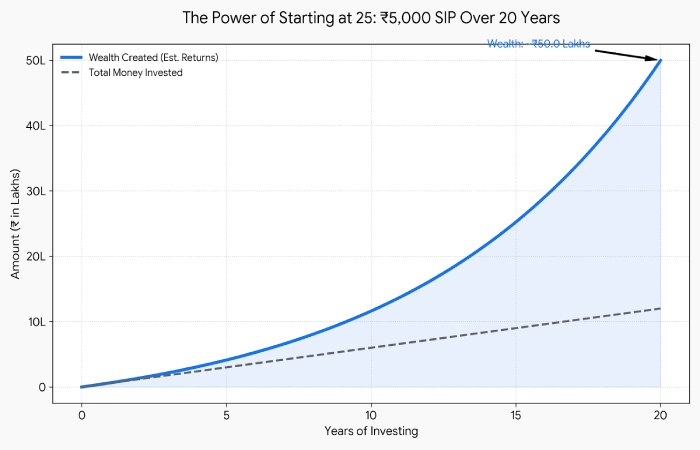
Projected growth of ₹5,000 monthly SIP at 12% over 20 years—demonstrating the power of compounding.
Key Insight
| Phase | Growth Behavior |
|---|---|
| Years 1–5 | Slow |
| Years 5–10 | Moderate |
| Years 10–20 | Exponential |
Step 5: Best Investment Options in India
| Instrument | Risk | Return Potential | Lock-in | Ideal Role |
|---|---|---|---|---|
| Index Funds | Moderate | 10–12% | None | Core growth |
| PPF | Low | 7–8% | 15 years | Stability |
| ELSS | Moderate | 10–12% | 3 years | Tax saving |
| Gold ETFs | Low–Moderate | 6–8% | None | Hedge |
Step 6: Income Growth vs Investment Returns
This is where most beginners go wrong.
If you’re still asking “i’m 25 and earning ₹30k a month how should i start investing for long-term growth?”, understand this: Increasing income beats increasing returns.
Comparison
| Strategy | Monthly SIP | Return | 10-Year Value |
|---|---|---|---|
| Higher returns | ₹5K | 15% | ₹13.9L |
| Higher SIP | ₹10K | 12% | ₹23L |
Conclusion
| Lever | Impact |
|---|---|
| Better stock picking | Low |
| Increasing SIP | High |
| Career growth | Very High |
Step 7: Automation Strategy (Set and Forget)
Manual investing leads to inconsistency.
Automation Flow
| Step | Action |
|---|---|
| Step 1 | Salary credited |
| Step 2 | SIP auto-debited (within 3 days) |
| Step 3 | Bills + expenses managed |
Benefits
| Problem | Solved By Automation |
|---|---|
| Forgetting to invest | Auto SIP |
| Market timing | Eliminated |
| Emotional decisions | Reduced |
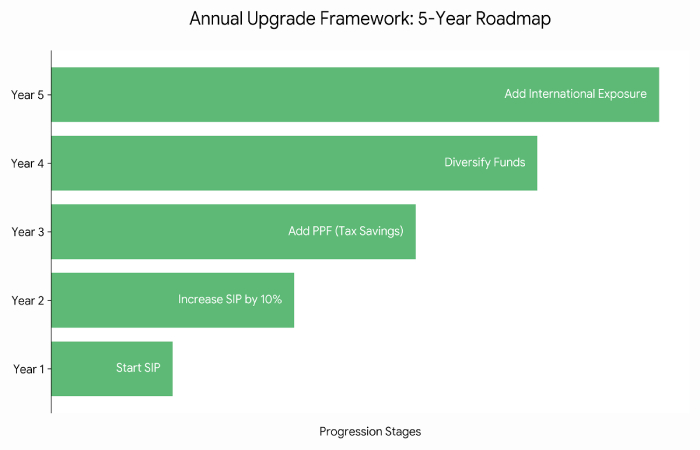
Step 8: Annual Upgrade Framework
Your investment plan should evolve yearly.
| Year | Action |
|---|---|
| Year 1 | Start SIP |
| Year 2 | Increase SIP by 10% |
| Year 3 | Add PPF |
| Year 4 | Diversify funds |
| Year 5 | Add international exposure |
Step 9: Risk & Market Reality
Markets are volatile. That’s normal.
Historical Market Falls
| Event | Market Drop | Recovery Time |
|---|---|---|
| 2008 Crisis | -50% | ~5 years |
| COVID Crash | -35% | <1 year |
Investor Behavior Impact
| Action | Outcome |
|---|---|
| Panic selling | Loss |
| Staying invested | Recovery + gains |
Step 10: 5 Year Execution Plan
If you’re serious about solving “i’m 25 and earning ₹30k a month how should i start investing for long-term growth?”, follow this roadmap:
| Phase | Focus | Investment Level |
|---|---|---|
| Year 1–2 | Build emergency fund | ₹3K–₹5K SIP |
| Year 3–4 | Increase investments | ₹6K–₹10K SIP |
| Year 5 | Diversify | ₹10K+ SIP |
Common Mistakes to Avoid
| Mistake | Why It’s Dangerous | Better Alternative |
|---|---|---|
| Waiting for right time | Misses compounding | Start now |
| Over-diversifying | Reduces returns | Keep 2–3 funds |
| Trading frequently | High risk | Long-term investing |
| Ignoring inflation | Wealth erosion | Equity exposure |
What Actually Builds Wealth
“i’m 25 and earning ₹30k a month how should i start investing for long-term growth?”
The answer is not in finding the “best” investment.
It’s in building a repeatable system:
| Component | Role |
|---|---|
| Consistency | Drives compounding |
| Time | Multiplies returns |
| Income growth | Accelerates wealth |
| Discipline | Prevents mistakes |
Conclusion
While starting with 30k/month at 25 isn’t the end of the world, it could actually benefit you if done at the right time and in a disciplined manner. A basic system to follow: discipline expenses, build an emergency fund, and consistently invest through SIPs in index funds with a low expense ratio, along with something stable such as PPF.
Never look for short-term returns of high percent and fashionable funds but increase the income you gain from and year on year increase in investment amount step-by-step. There will be no market timing, or picking individual stocks, what really counts over a period of time will be steadily investment and patience.