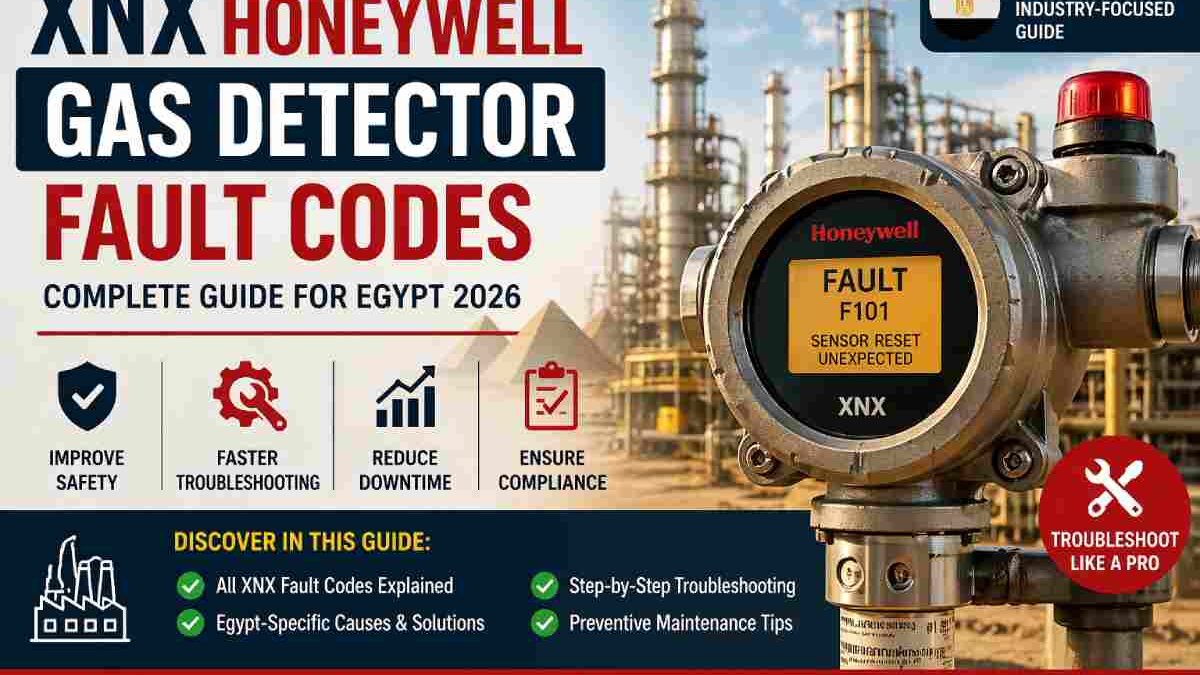
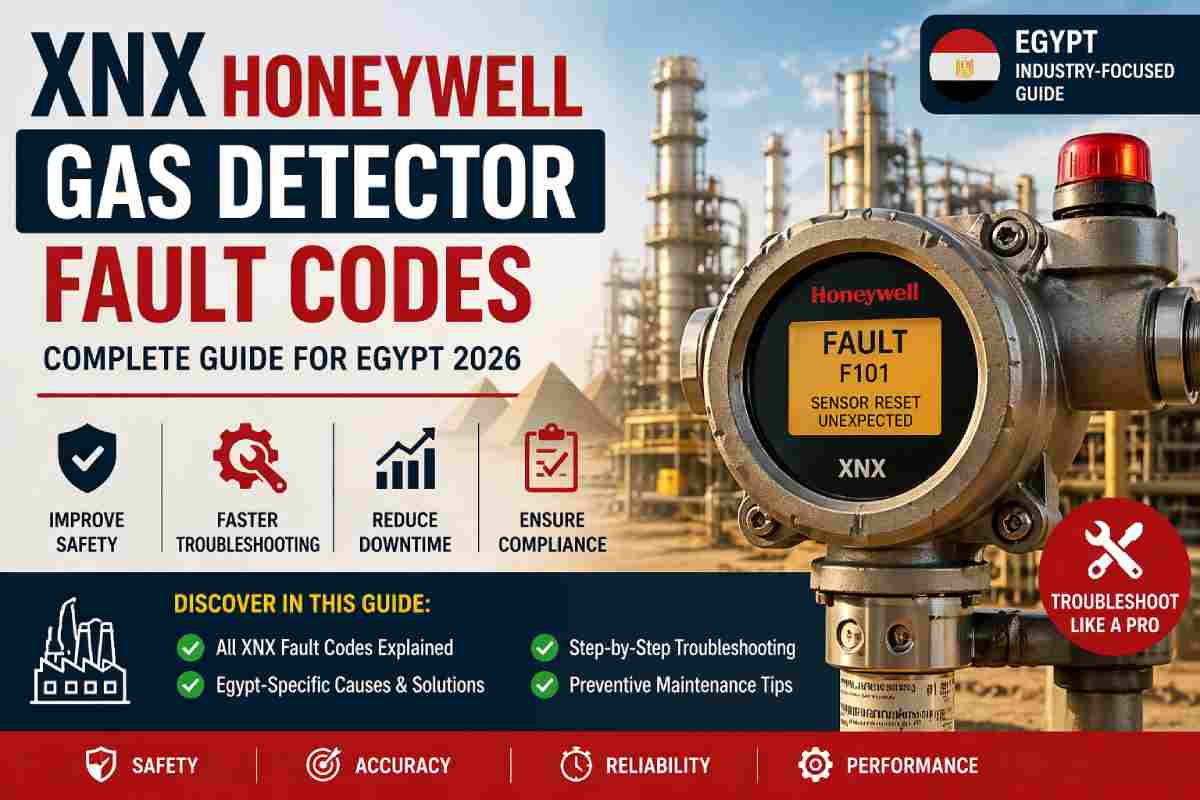
In Egypt’s high-risk industrial ecosystems-oil & gas facilities in the Gulf of Suez, petrochemical facilities in Alexandria, and water and wastewater treatment plants throughout Cairo-gas detection is the last line of defense; it’s a first-line safety control, not a second one.
Honeywell XNX Universal Transmitters are prevalent due to their ease of use with multiple sensor types (infrared, electrochemical, and catalytic). The one constant that engineers have repeatedly told me they experience with these systems throughout Egypt is:
Misinterpretation or ignoring of fault codes leads to a mismatch between detection capacity and actual safety performance.
Table of Contents
Understanding XNX Fault Code Architecture
Honeywell’s XNX transmitter comes equipped with an internal diagnostic system that constantly checks its own electronics, sensor response, and the environmental conditions the sensor detects. All of these faults can be classified into one of these four fault codes:
| Category | Code Range | System Area | Risk Level | Typical Frequency (Egypt) |
|---|---|---|---|---|
| Transmitter Faults | F100–F108 | Internal electronics | High | Medium |
| Sensor Faults | F111–F117 | Sensor module | High | Very High |
| Configuration Faults | F120–F123 | Setup & compatibility | Medium | Medium |
| Calibration Faults | F164–F165 | Accuracy system | High | High |
In Egypt, sensor and calibration faults dominate (~60–70%), primarily due to environmental stressors rather than manufacturing defects.
Core Transmitter Fault Codes
These faults originate from the XNX device itself, not the attached sensor.
| Fault Code | Description | Technical Cause | Egypt-Specific Trigger | Recommended Action |
|---|---|---|---|---|
| F101 | Sensor Reset Unexpectedly | Voltage instability | Grid fluctuation / generator switching | Install voltage stabilizer |
| F103 | Temperature Error | Internal overheating | Direct sun exposure (desert sites) | Add sunshield / ventilation |
| F104 | 24V Supply Fault | Power supply issue | Poor PSU quality | Check regulated supply |
| F105 | 3.3V Rail Failure | PCB fault | Component aging under heat | Replace board |
| F106 | Clock Failure | RTC malfunction | Battery degradation | Replace internal battery |
| F107 | Memory Failure | Firmware corruption | Power spikes | Firmware reload / OEM |
| F108 | mA Output Fault | Loop signal failure | Cable corrosion | Inspect 4–20mA loop |
Variability in power infrastructure—especially in remote oil fields—makes F101 and F104 among the most frequent transmitter faults.
Practical Observation: Engineers often replace sensors unnecessarily when the actual issue is power instability.
Sensor Fault Codes – Most Critical Category
Sensor-related faults represent the highest failure rate in Egypt due to environmental exposure.
| Fault Code | Meaning | Root Cause | Environmental Factor | Fix |
|---|---|---|---|---|
| F111 | Negative Drift | Sensor aging | Dust contamination | Zero calibration |
| F112 | Sensor Power Fault | Wiring issue | Heat-damaged insulation | Repair wiring |
| F113 | Internal Sensor Fault | Sensor failure | Long-term exposure | Replace sensor |
| F114 | IR Lamp Failure | Optical degradation | Dust + hydrocarbons | Replace IR module |
| F116 | General Sensor Failure | Internal damage | High temperature | Replace sensor |
| F117 | Loop Failure | Signal interruption | Corrosion / loose wiring | Fix connections |
Sensor Lifespan vs Environment Severity
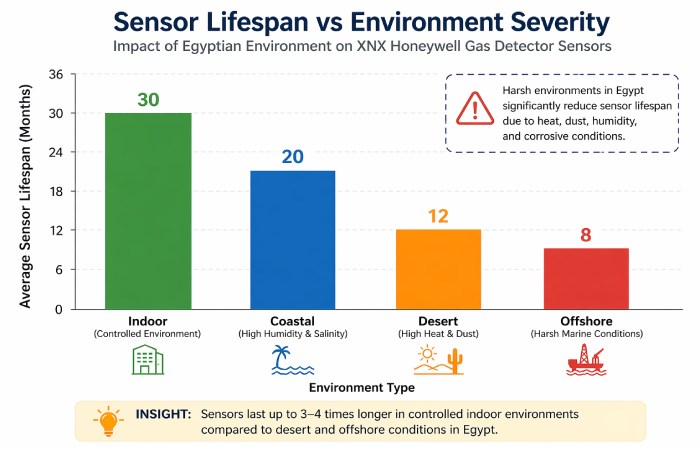
Why Sensors Fail Faster in Egypt
| Factor | Effect on Sensor | Resulting Fault Codes | Severity |
|---|---|---|---|
| High temperature (>45°C) | Accelerates aging | F113, F116 | Critical |
| Dust & sand | Blocks sensing elements | F111, F114 | High |
| Humidity (coastal areas) | Corrosion | F117 | Medium |
| Hydrocarbon exposure | Poisoning (catalytic sensors) | F116 | Critical |
Configuration & Communication Faults
These faults occur when the transmitter and sensor are not correctly aligned.
| Fault Code | Description | Root Cause | Common Scenario in Egypt | Solution |
|---|---|---|---|---|
| F120 | No Sensor Detected | Disconnection | Loose terminals | Reconnect sensor |
| F121 | Wrong Sensor Installed | Compatibility mismatch | Incorrect spare usage | Install correct cartridge |
| F122 | General Diagnostic Fault | Multiple issues | Poor maintenance | Full system check |
| F123 | Sensor Temperature Fault | Overheating | Outdoor installation | Add protection |
At Egyptian industrial sites, F121 is common due to poor spare-part management, especially when procurement teams source non-standard components.
Calibration Fault Codes
The Calibration errors are among the most dangerous faults because they can produce false safe readings.
Calibration Fault
| Fault Code | Meaning | Cause | Egypt-Specific Issue | Action |
|---|---|---|---|---|
| F164 | Sensor mV Failure | Signal degradation | Aging sensors | Replace sensor |
| F165 | Calibration Failure | Incorrect calibration | Low-quality gas | Recalibrate properly |
Calibration Risks in Egypt
| Issue | Impact | Result |
|---|---|---|
| Non-certified calibration gas | Inaccurate readings | False safety assurance |
| Irregular calibration schedule | Sensor drift | Missed gas leaks |
| Poor technician training | Incorrect setup | Repeated faults |
Step-by-Step Troubleshooting Framework
Professional engineers follow a structured diagnostic workflow rather than guessing.
| Step | Action | Tools Required | Outcome |
|---|---|---|---|
| 1 | Identify fault code | Display panel | Define issue |
| 2 | Check power supply | Multimeter | Rule out PSU faults |
| 3 | Inspect wiring | Visual + tester | Detect physical issues |
| 4 | Evaluate sensor | Calibration kit | Confirm sensor health |
| 5 | Perform calibration | Certified gas | Restore accuracy |
| 6 | Reset system | Interface panel | Clear temporary faults |
| 7 | Escalate | OEM support | Resolve internal faults |
Preventive Maintenance Strategy
Preventive maintenance is the single biggest factor in reducing fault frequency.
Maintenance Schedule
| Activity | Frequency | Purpose |
|---|---|---|
| Visual inspection | Weekly | Detect physical damage |
| Bump test | Monthly | Verify response |
| Full calibration | Quarterly | Ensure accuracy |
| Sensor replacement | 12–24 months | Avoid failure |
| System audit | Annually | Ensure compliance |
Maintenance Impact
| Maintenance Quality | Fault Frequency | Operational Risk |
|---|---|---|
| Poor | Very High | Critical |
| متوسط (Average) | Moderate | Medium |
| Professional | Low | Minimal |
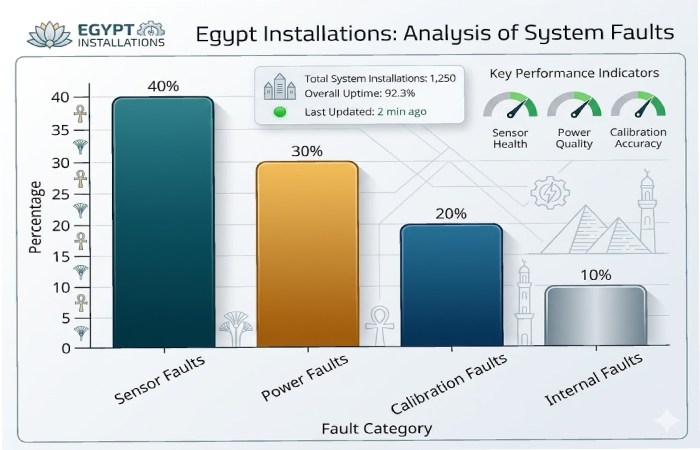
Data Insight: Fault Distribution in Egypt
Based on field observations and maintenance logs:
| Fault Category | Percentage | Primary Cause |
|---|---|---|
| Sensor faults | 40% | Environmental damage |
| Power faults | 30% | Unstable supply |
| Calibration faults | 20% | Poor practices |
| Internal faults | 10% | Hardware issues |
Fault Distribution
Beginner Mistakes
| Mistake | Why It Happens | Consequence | Fix |
|---|---|---|---|
| Replacing sensor immediately | Lack of diagnosis | Unnecessary cost | Check power first |
| Ignoring minor faults | Underestimating risk | System failure | Investigate all faults |
| Using cheap calibration gas | Cost-cutting | False readings | Use certified gas |
| No environmental protection | Oversight | Frequent failures | Install shields |
Advanced Technical Insight
The XNX platform supports multiple sensing technologies, which introduces complexity:
Sensor Type Comparison
| Sensor Type | Strength | Weakness | Egypt Suitability |
|---|---|---|---|
| Infrared (IR) | Stable, long life | Expensive | Excellent |
| Catalytic | Fast response | Poisoning risk | Moderate |
| Electrochemical | High sensitivity | Short lifespan | Limited |
Engineering Insight
For Egypt:
- IR sensors are preferred in oil & gas
- Catalytic sensors require frequent replacement
- Electrochemical sensors struggle in high heat
Environmental Risk vs Fault Probability
| Environmental Factor | Probability of Fault | Most Affected Codes |
|---|---|---|
| Extreme heat | Very High | F103, F123 |
| Dust storms | High | F111, F114 |
| Power fluctuation | High | F101, F104 |
| Humidity | Medium | F117 |
Practical Field Checklist
| Task | Status Check |
|---|---|
| Display shows normal operation | ✔ |
| No active fault codes | ✔ |
| Wiring intact | ✔ |
| Sensor clean | ✔ |
Bottom Line
The Honeywell XNX fault code system is not just a warning—it is a precision diagnostic tool. In Egypt, most faults are driven by environmental stress, power instability, and poor calibration practices, not device failure. Most XNX Honeywell fault codes in Egypt are driven by environmental stress (heat, dust), unstable power, and poor calibration practices—not actual device failure. Teams that diagnose systematically and maintain regularly can significantly reduce downtime, improve safety accuracy, and extend sensor life.